GLINT history
3Dlabs is now a vanishing brand of professional 3d graphics, but once upon a time was a leading company in the field. Already in 1985 the founding british duo boldly set on to build the fastest 3d engine. They turned some heads but true fame came in 1994 with the 300SX chip, a low cost texture mapper which defined standards of 3d acceleration. First it should be told the Glint 300SX was designed in Pixel division of Du Pont, which was working with graphics for 10 years and became well known name in 3d world, especially on Sun systems. With advanced hardware and mainly software Du Pont Pixel was quite a competitor for solutions of Silicon Graphics. Just after announcing development of relatively cheap and feature packed 300SX chip, Du Pont agreed to sell the Pixel division to fresh start up 3Dlabs and most of the important people transferred as well. Which makes me wonder if they regretted it later. Or is it necessary to have a specialized graphics company to be successful in 3d technologies? 300SX powered professional 3D graphics cards were spreading in scale unheard of before 1995. This site is all about gaming cards, but I found it impossible to write about 3Dlabs without mentioning influential chip like the Glint. First single chip 3d accelerator with texture mapping pushed prices down to around $2000, which was unheard of before in workstation world.
First of the line
300SX had all the rendering, fragment processing and rasterisation operations of OpenGL on a single chip and "full speed" Z-buffering, dithering and anti-aliasing. At its 50 MHz frequency it claimed rendering speed of 300,000 Gouraud shaded, depth buffered and anti-aliased polygons per second. Two clocks are needed to fill one smooth shaded pixel and the rate is halved whith depth buffering. 32 bit datapath is maintained from beginning of the pipeline to the end. The chip provided complete 2D and 3D acceleration in true color, PCI interface and along with LUT-DACs support for palletized textures. Frame buffer used 64 bit VRAM interface and optional DRAM memory with 48 bit bus could store depth buffer, masks and other graphics data, except textures. Many technologies similar to buzzwords of our time appeared already back then. Fujitsu Microelectronics has developed a proprietary technology called PixelBus which allows you to link multiple Glint cards together to get increased speed. PixelBus also supports a synchronized output mode for panoramic display systems. Relatively cheap 300SX was a great success and 3Dlabs of course continued improving the architecture. The first step should have been the GLINT 300TX with texture mapping from local memory. This was to be the main goon for arcade developers. At the time 3Dlabs did not shy away from games as API work shows- Reality Lab and BRender support was prepared. The 300TX claimed Gouraud shaded, depth buffered, window clipped, stippled, dithered and alpha tested rendering performance with 24-bit colors of 300K 25 pixel triangles per second. However, it did not materialize, at least not under that name. Another Glint product came around and it had very different purpose.
3D Blaster VLB
In 1995 3Dlabs targeted gamers and managed to reduce price to level suitable for consumer market and together with Creative launched 3D Blaster for Christmas. As the only texture mapper for VL-Bus this card is truly special, limited to 486 platform with exception of rare Socket 4 and 5 boards.
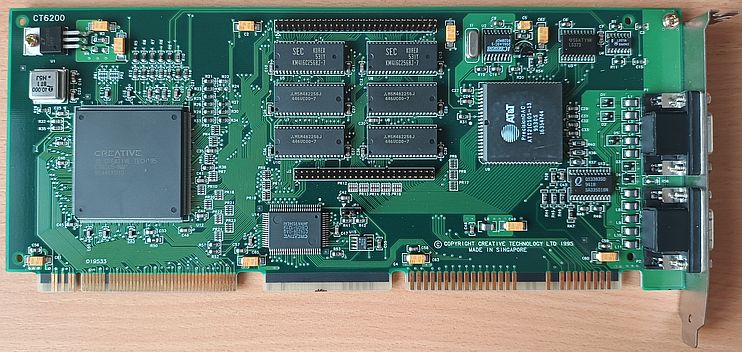 I assume Creative was eager to be the first with consumer texture mapper, but Diamond Edge 3D arrived to the market several days before.
I would love to test the 3D Blaster VLB, but to do something new with it I first need a forementioned motherboard to try the card without CPU limitations. The games-tuned GLINT chip promised arcade-quality 3D performance and texturing with true perspective correction and filtering, fogging, blending, translucency, and stencils at the minimum possible cost. It is an add on 3d card, but it can also accelerate GUI and several video codecs. Creative felt confident even against new 32 bit consoles, which was too good to be true. Memory capacity had to be squished to achieve consumer friendly pricing. Colors at higher resolution were therefore limited to 8 or 16 bits. Geometry performance with texturing was reduced by one third and speed of Glint architecture was quite sensitive to features used in rendering. Theoretical fillrate of 25 megapixels/second is just so so for 640x400x16. Memory consisted of 1MB DRAM for textures and Z-buffer and 1MB VRAM frame buffer. Obviously, one cannot expect much jaw dropping 3d within such limits. The 3D Blaster VLB promised Direct3D driver, but when Microsoft finally released the API there was little the Gaming Glint could do. Creative took their time with driver and memory expansion module. That was additional $50 to get capacity assuring d3d compatibility. Even Creative's name did not attract enough game developers to ensure that any big number of 3d-enabled titles will be running on the 3D Blaster. And yes, Creative claimed several hundred high-end GLINT boards were seeded to key game developers at the beginning of 1995 and received excellent feedback on 3D Blaster's rendering quality and functionality. As I look at it only hardware devs could get at the time was 300SX, which means less memory restrictions then 3D Blaster. Only a small fraction of seeded developers come up with Gigi ports. Another revolution like with Sound Blaster years earlier was much harder to pull off, even bundled games were running slow. Consumers wouldn't risk $349 even though there were five or six mostly attractive games bundled: early on Magic Carpet Plus, Cybersled, Azreal's Tear, NASCAR, Magic's Ballz Out! and Flight Unlimited. Later Hi Octane! using antialiasing was added as well. For gamer was much safer to upgrade from 486 than to purchase a VL-Bus 3D add-on card which you cannot carry to your next system. Having no competition on a massive install base was just not enough to sell. Creative planned PCI version with AWE32 wavetable audio for spring 1996 and for early '97 even a version with integrated 28.8Kbps modem for multiplayer gaming. Something obviously changed their minds, which is most probably good thing. Ambitions to dominate 3d acceleration via Gaming Glint vanished. But were competing companies which delivered their chips before Christmas 1995 doing better? Nvidia NV1 or Yamaha RPA had the same fate, 3D Blaster VLB at least had game library containing more than several games.
In summer 1996 came also professional high end Glint 500TX, here is Elsa Gloria L/M: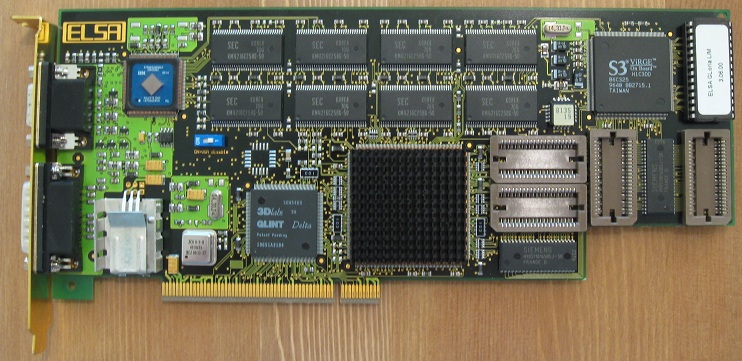 In the center monstrous 500TX, left of it coprocessor Delta, on the right Virge for basic VGA functions.
In one year all this functionality would be integrated into Permedia 2 chip.
By the end of 1996 3dlabs had first fully integrated all-around chip and was hoping for mainstream breakthrough.
continue to Permedia review
In the center monstrous 500TX, left of it coprocessor Delta, on the right Virge for basic VGA functions.
In one year all this functionality would be integrated into Permedia 2 chip.
By the end of 1996 3dlabs had first fully integrated all-around chip and was hoping for mainstream breakthrough.
continue to Permedia review